
Why Mechanical Testing Matters
Even today, mechanical testing continues to unlock material secrets and therefore directly enables technological breakthroughs. Quantifying how materials behave under stress, strain, temperature and time, enables engineers to design with confidence, pushing the barriers of performance and safety.
Advancements in very high temperatures (e.g. >1000°C) and creep (time-dependent deformation) and stress rupture testing have been fundamental in understanding turbine blades in jet engines and gas turbines. Without these generated data on how superalloys deform over thousands of hours at high temperatures, modern and efficient aviation travel and power generation turbines would be impossible. Moreover, assessing the long-term integrity of reactor core components and piping at high operating temperatures relies entirely on creep and stress rupture testing.
The development of fracture mechanics as a discipline delivers quantitative parameters like fracture toughness, measuring materials' resistance to crack propagation rather than just its strength. This enabled fail-safe and damage tolerance aircraft design methodologies, allowing structures to be designed to withstand a specific crack size without catastrophic failure. This is a fundamental principle in modern aerospace, leading to lighter, safer, and more durable airframes. This is equally important in large-scale civil engineering, the safe design of critical structures like pressure vessels and pipelines, accounting for the pressure of inevitable flaws from manufacturing or service.
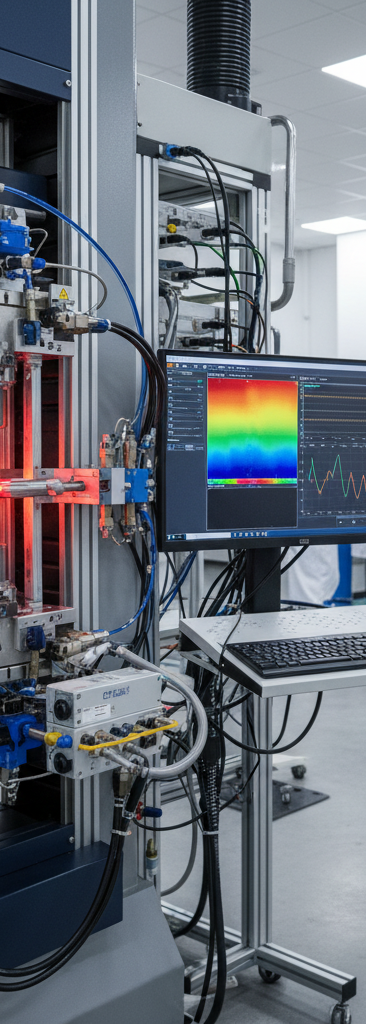
Advancement in nanoindentation and micromechanical testing allows for mechanical characterisation of very small volumes of materials, thin films and even individual microstructural features. This has advanced semiconductors and microelectronics for which integrity of thin films on a computer chip is critical. Digital image correlation and full-field strain mapping, a non-contact optical technique using cameras to track deformation of a speckled pattern on a sample, provides a high-resolution map of strain and displacement in real-time. This has been beneficial in the development of composite material, understanding complex failure mechanisms like delamination, fibre buckling and matrix cracking.
In-situ mechanical testing using scanning and transmission electron microscopy allows researchers to observe micromechanisms of deformation like crack initiation, void formation and dislocation movement as tests are performed. These have revealed how microstructures lead to macroscopic properties, guiding the development of new alloy design like high-entropy alloys.
So yes, mechanical testing matters and remains a critical enabler, moving material development from an artisanal, Edisonian process to a science-driven discipline. With each test breakthrough providing essential data and understanding needed to de-risk and realise future transformative technologies from the gas turbines to the digital and manufacturing revolution.
Dr Coasta Coleman Oct 2025